
What should you know about the first teeth?
The first teeth appear at quite different times. For some children the first baby tooth appears from the 4th month, for others shortly before their first birthday. We always answer parents’ worried questions about when, in which direction and at what intervals the teeth appear.
The most general answer is that until the age of one, there is no problem with when the first tooth appears. It is also not a problem if the tooth erupts at an angle. There is plenty of room in the jaw, so sometimes a tooth comes in completely tilted or crosswise, but as a rule it turns into place nicely, especially as other teeth appear.
Caring for baby teeth
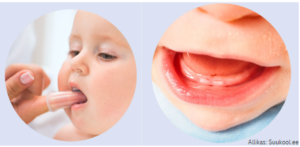
Teeth should be brushed twice a day. For a baby, simply try to find a time during the day when the child is in a good mood and make brushing a pleasant daily routine. Choose a comfortable position for the child – lying down or standing. You can be behind the child’s head or in front of their face; the main thing is that the child is comfortable and you can see their teeth.
Try to make brushing playful and fun. For example, sing a song or talk about teeth or germs while you brush. You can give the child a toy to distract them.
The first visit to the children’s dentist
If the child breastfeeds at night and you notice damage to the enamel, come for a consultation as soon as the first whitish or brownish spots appear on the teeth. We diagnose the problem and can coat the teeth with a protective varnish at the clinic or prescribe a remineralising cream that restores the tooth tissue.
In any case, the first dental visit should be between the ages of 12 and 24 months.
At the first visit, the parent sits in the dental chair with the child and we try to get the child to agree to show us their teeth. Preparing at home really helps: if what happens at the dentist has been explained to the child and played through at home, the first visit is very pleasant for everyone. After showing their teeth, the child can choose a small gift.
It is best to keep stories about dental experiences from the last century away from the child – as the child has no previous experience, such ideas can easily be amplified.
It is nice to tell the child how good dentists are and that they help children. Encourage the child to take care of their own health, because it is the child who is doing a great job and wants everything to be fine. Both the parent and the dentist are there to help.
Although we sometimes think a child is so small, children are actually very brave and happily take part in their treatment – that is when they feel that they themselves need it.
You can find lots of useful information about children’s oral health at SUUKOOL.EE