Implantology

What is a dental implant?

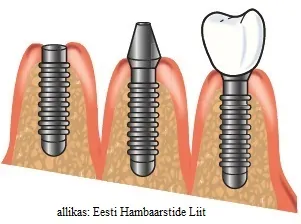
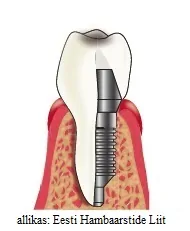
Dental implants (artificial tooth roots) are used to replace single teeth and to support longer bridges, while mini-implants are used to hold partial dentures in place. An implant replaces a missing tooth without involving the neighbouring teeth.

HambaimplantaatWhat should you consider when getting a dental implant?

  • If there is not enough bone, a bone augmentation procedure is needed first.
  • If the teeth have shifted because of a missing tooth, orthodontic treatment may be needed first.
  • Sometimes plastic surgery of the soft tissues around the tooth is also needed.
  • As placing a dental implant means fixing an artificial root in the jawbone, the risks are the same as with any artificial material placed in the body. Experience shows that problems occur in fewer than 10% of cases. Occasionally a “rejection reaction” may occur, i.e. the jawbone does not accept the implant.
  • After placement, you will need to take a painkiller for 1 day and antibiotics for 5 days.
  • Initial healing takes 2 weeks and bone integration 2 months, but the final restoration (artificial tooth) can be made from the 4th month up to a year later, i.e. once the dental implant has integrated into the bone.
  • In the meantime, a temporary denture will most likely be needed for larger gaps.

How is a dental implant placed?

1st visit

  • Consultation.
  • X-ray examination.
  • Measurement of bone and soft tissue parameters.
  • Explanation to the patient and answers to questions.

For larger treatments involving several implants, impressions are taken and a surgical guide is ordered from the laboratory to ensure the best angles for placing the implants.

Once the placement date has been agreed, the patient starts a course of antibiotics 1 day before.

2nd visit

The dental implant is placed under local anaesthesia. First we make sure that the anaesthesia has taken full effect, and then the implant is placed. Placing one implant takes about 25–35 minutes. Where possible, a healing abutment is fitted and stitches are placed.

3rd visit

  • Checking the wound and removing the stitches.
  • X-ray check.

4th visit

From the 4th month, the final restoration is made (see dental crown).

Complications in implantology

What problems can occur when placing dental implants?

  • In the lower jaw – the risk of entering the nerve canal.
  • In the upper jaw, the risk is the maxillary sinuses.

To avoid this:

The parameters can be measured very accurately from an X-ray. As we use 3D X-rays, the area around the implants can be thoroughly examined and measured in advance. The implant is always chosen slightly shorter to avoid any risk.

When should crowns be placed on implants?

Crowns on implants are recommended to be placed from the 4th month up to 1 year after implant placement. For aesthetic reasons, implants can be loaded immediately after placement if the torque with which the implant is anchored in the jawbone allows it. The patient can adjust the exact timing to suit their schedule.

At the 1st visit

  • The material and shade of the new tooth are chosen.
  • The healing abutments are removed.
  • Impression components are attached.
  • Impressions or scans are taken of both jaws and the bite is recorded.
  • The healing abutments are put back.

At the 2nd visit

  • The abutment is checked.
  • For a smaller restoration, the crown can be made right away and cemented in the mouth.
  • The abutment is fixed separately and tightened with the instrument of the relevant system. The crown is then cemented onto the abutment; if necessary, 1 more visit is needed.

What should you consider when getting crowns?

  • Building a crown on an implant is practically risk-free.
  • Good oral hygiene and a regular check-up once a year are important afterwards; at the slightest problem, contact the dentist who placed the implant.

It is best for the dentition if each tooth is restored individually and the whole row of teeth functions as physiologically as possible.

Do crowns need special care?

Correct crown margins and smooth transitions from the crown to the abutment are easy to clean. With today’s precise methods, food and bacteria rarely build up. For the daily care of teeth with crowns, in addition to normal brushing we strongly recommend using mouthwash and an air-floss (water flosser) device. In addition, a professional cleaning of the whole mouth with Air-Flow cleaning is needed once a year.

At the slightest problem with your implants, contact the dentist who carried out the implant work as soon as possible.

The Estonian Dental Association has also prepared a detailed information leaflet on dental implants, which you can read HERE.

See implantology prices HERE