
Root canal treatment, or endodontics, means diagnosing and treating inflammation of the dental pulp and its consequences. Root canal treatment is carried out on a tooth whose nerve (pulp) has become infected, usually through a deep cavity, causing inflammation. The inflammation may have spread below the root of the tooth into the jawbone. By then the tooth itself has a dead nerve and is non-vital.
Root canal treatment (endodontics)
During root canal treatment:
- The damaged dental nerve is removed.
- The root canals are carefully cleaned (1–3 canals, sometimes 4).
- The bacterial infection is treated.
- If there is inflammation below the root, calcium-containing pastes are used to help the jawbone heal, and the healing is monitored.
- The root canals are filled and hermetically sealed.
- The tooth crown is restored.
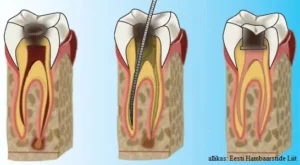
Root canal treatment takes time and requires at least 4 visits. The last visits may be 2–3 months apart to give the jawbone time to heal.
What should you bear in mind with root canal treatment?
Circumstances that complicate and limit root canal treatment:
- The anatomy of root canals varies greatly (roots may be curved, narrowed, calcified, etc.).
- A tooth that has already had root canal treatment may have blocked sections that cannot be opened. Previous treatment may have created ledges in the root canal, and occasionally an instrument may have broken inside the canal.
- If the patient has difficulty opening their mouth or a strong gag reflex.
- Pregnancy (successful treatment requires several control X-rays).
- Antibiotics often need to be taken during treatment.
- The patient’s work involves conditions that do not favour recovery (draughts, cold).
- There is a risk of perforating the floor of the pulp chamber, and the root filling may extend slightly beyond the root tip.
In such cases the situation is always handled individually.
- In up to 10% of cases, root canal treatment also requires surgery, i.e. opening the area below the root, cleaning it and filling the defect with a bone substitute.
- In up to 5% of cases, root canal treatment is unsuccessful and the tooth has to be extracted.
More information is available in the INFORMATION LEAFLET prepared by the Estonian Dental Association
See root canal treatment prices HERE